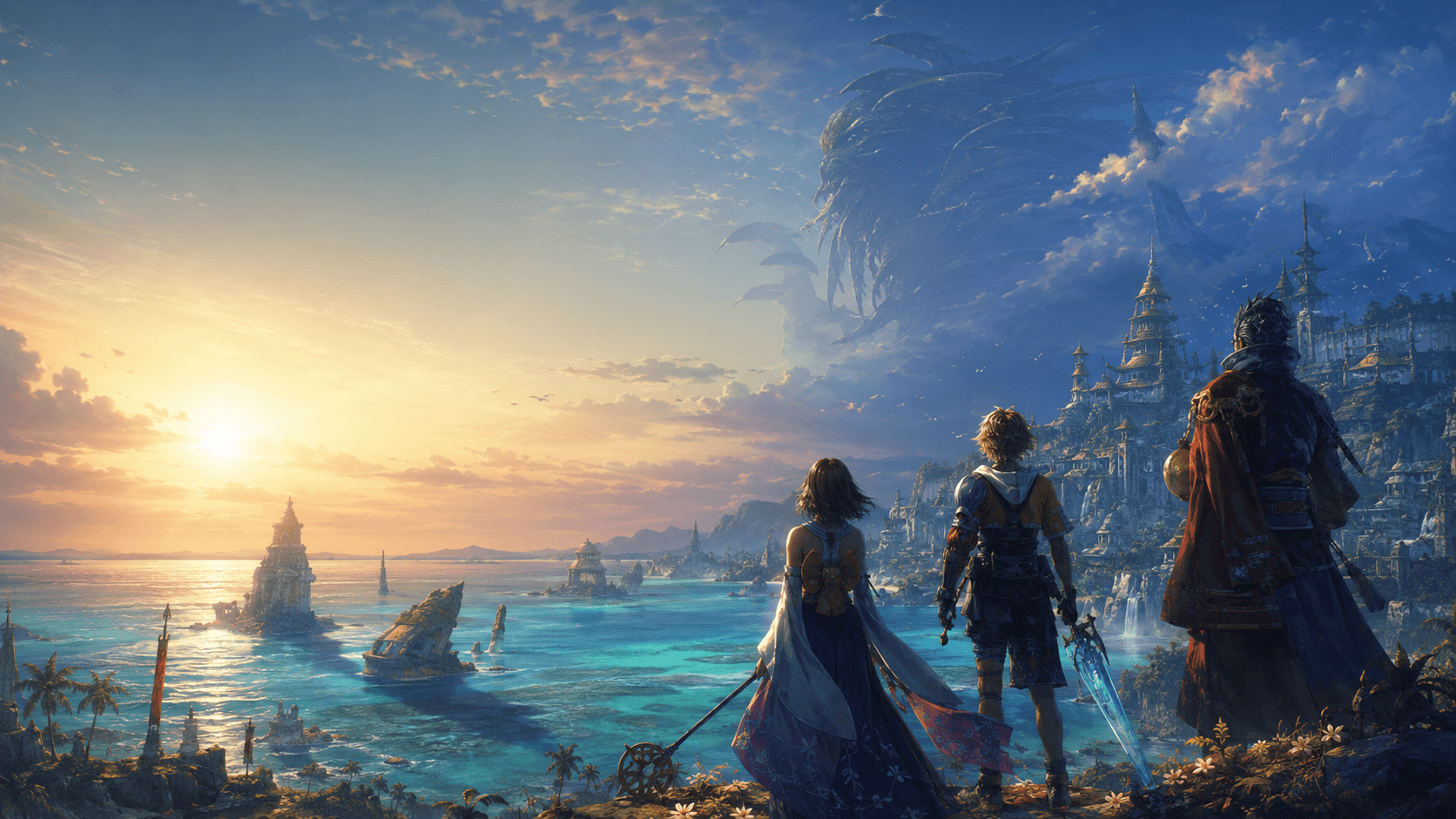


Spoiler warning: This article contains spoilers for the story of Final Fantasy X.
There are games you play, finish, put aside, and then simply move on to the next one. And then there are games that leave something behind. Something that cannot be measured through trophies, completion percentages, review scores, or lists of the greatest games of all time.
For me, Final Fantasy X clearly belongs to the second category.
After roughly 175 hours today, and with the memories of an entire summer back in 2002 still somewhere in Spira, Final Fantasy X is not just a game I completed again. It is a world I returned to, carrying with me the player I used to be back then.
I did not get the platinum trophy. I did not do everything. I did not reach the point where I fully exhausted every possible endgame objective the game has to offer. But 175 hours are more than enough to say that you lived inside a world. That you got to know its characters. That you understood its pain, its faith, its contradictions, and its hopes.
More than anything, they are enough to remind you why some games do not remain important simply because they were impressive for their time. They remain important because they had soul.
Final Fantasy X is not just a JRPG. It is a journey about loss, growing up, religion, sacrifice, hope, and the need to break a cycle that everyone before you believed was impossible to break.
And that is exactly what still makes it so special today.
Spira: A World That Learned to Live With Death
From its first hours, Final Fantasy X throws you into a world that looks beautiful, colorful, and full of life. Beaches, temples, villages, rituals, journeys, music, water, sky, nature. Spira has an almost dreamlike quality.
But the longer you stay there, the more you realize that beneath that beauty lies a deeply wounded world.
Spira lives under the shadow of Sin. Not as a simple final boss that needs to be defeated, but as a permanent disaster that returns again and again. This world is not truly waiting to be saved. It is simply waiting for the next brief moment of peace before the nightmare comes back.
That is one of the strongest parts of the game’s lore. Spira is not a society built on progress or optimism. It is built on the acceptance of pain. People have learned to live with the idea that Sin will return. They have learned to grieve. They have learned to hope for a temporary Calm. And they have learned to believe that this Calm can only come through the sacrifice of a summoner.
This is where the religion of Yevon comes in, not simply as background lore, but as one of the central mechanisms of the world. Yevon gives answers. It gives order. It gives meaning to fear. It tells people why they suffer and what they must do in order to endure.
But as the story moves forward, it becomes clearer and clearer that this faith is not only a source of comfort. It is also a prison.
Spira is a world trapped inside its own tradition. A world that has been convinced that sacrifice is normal, that death is inevitable, and that questioning the system is almost a sin in itself.
And that is exactly where the power of the story lies. Final Fantasy X does not simply tell you, “Go and defeat the monster.” It tells you, “Look at a world that has learned to survive through a lie, and find the courage to tell it there is another way.”
A Story That Begins as an Adventure and Becomes Something Much Deeper
At first, everything seems to revolve around Tidus. A famous blitzball player from Zanarkand, a young man full of energy, ego, wounds, and anger, suddenly finds himself in a world he does not understand. His father, Jecht, is a shadow that follows him everywhere. His home seems lost. The reality around him makes no sense.
And in that moment, the player is placed in the exact same position. You do not fully understand Spira. You do not know why everyone accepts sacrifice so calmly. You do not know why people speak about Sin with such fear and reverence. You do not know why Yuna continues her pilgrimage while everyone around her seems to know something you do not.
That is excellent storytelling.
The game uses Tidus as the player’s window into Spira. His ignorance is our ignorance. His questions are our questions. His discomfort with the rules of this world is our discomfort too.
But as the story progresses, Final Fantasy X shifts its emotional center. It is not only Tidus’ story. It becomes Yuna’s story. The story of a young woman carrying the hopes of an entire world on her shoulders, while knowing that the price of her mission is something the people around her can barely say out loud.
And then it becomes even bigger. It becomes the story of Spira itself. The story of a world that must decide whether it will continue obeying a cycle of suffering or dare to break it.
What makes the story beautiful is that it does not evolve only through plot twists. It evolves emotionally. The more you learn, the more the meaning of earlier scenes changes. Things that seemed simple, innocent, or almost routine at first later gain weight. Looks, silences, lines of dialogue, choices, all of them begin to carry a second meaning.
That is something very few games manage to do this well.
Cinematic Cutscenes That Felt Like the Future
Today, we are used to high production values. We have seen games with cinematic direction, motion capture, excellent voice acting, and cutscenes that feel like films. But when Final Fantasy X arrived, the feeling was different.
For its time, it was genuinely impressive.
Its cutscenes were not just pretty videos placed between gameplay segments. They were moments that gave the story another dimension. The camera work, the music, the faces, the direction, the rhythm, everything pointed to a game trying to approach cinema without losing its identity as a JRPG.
The opening with blitzball and the destruction of Zanarkand had energy and scale. The first major encounter with Sin had awe. The Sending showed that this world treats death not only as tragedy, but also as ritual. Operation Mi'ihen felt like a desperate battle against something far beyond human strength. The wedding, Bevelle, Macalania, Zanarkand, the ending, all of these scenes stay in memory not simply because they were impressive, but because they carried emotional weight.
And yes, today you can see the wrinkles of time. You can tell that this is a game from another era. Some facial expressions may feel stiff. Some voice performances may sound strange by modern standards. But none of that erases the impact these scenes could have back then.
For many of us, these cutscenes were among the first times we felt that a video game could have the scale, emotion, and direction of a major film, but with the personal connection only a game can offer.
Because you do not simply watch it.
You live it.
Tidus: The Hero Who Learns to Listen
At first, Tidus can seem annoying to some players. He is loud, emotional, reactive, full of anger and insecurity. He is not the classic silent hero who enters a world and understands everything with quiet dignity.
And that is exactly what makes him interesting.
Tidus is someone who is ripped away from his reality and forced to grow up inside a world that does not owe him explanations. His relationship with Jecht is the wound that shapes much of his personality. This is not simply a story about an absent father. It is the story of a father who was, at the same time, an idol, a trauma, and a shadow.
Tidus’ true journey is not only about discovering what happened to Zanarkand or what Sin really is. It is about learning to look beyond himself. To understand Yuna. To understand Spira. To understand Jecht. To accept that growing up often does not come when you receive answers, but when you are strong enough to face the truth.
By the end, Tidus becomes something much more meaningful than a “chosen hero.” He becomes someone who chooses to stand beside others, even when the truth breaks him apart.
Yuna: The Heart of Final Fantasy X
Yuna may be the most important character in the game. Not simply because she is the summoner. Not simply because the pilgrimage is built around her. But because every major theme of Final Fantasy X lives inside her.
Faith and doubt. Duty and desire. Sacrifice and hope. Personal life and collective responsibility.
Yuna is not weak because she is calm. Quite the opposite. Her calmness is the form her strength takes. She knows what the world expects from her. She knows what her journey means. She knows that everyone loves her, but at the same time, everyone has accepted her loss as part of the solution.
That is what makes her so moving. She does not constantly shout. She does not demand attention. She does not try to convince anyone that she is brave. She simply keeps moving forward.
And the further she goes, the more you realize that Yuna is not simply a heroine who needs to be saved. She is the person carrying the emotional weight of the entire story.
Her relationship with Tidus works so well because it is not just romantic. It is a relationship between two people who learn from each other. Tidus shows her that she can question the path that was given to her. Yuna shows him what it means to carry responsibility without losing kindness.
And that is rare.
Auron: The Man Who Carries the Truth
Auron is one of those characters who immediately feels like he knows more than he says. He has the presence of a veteran, of a man who has already lived through tragedy and has now returned not to become a hero, but to finish something that was left unresolved.
He is not simply the “cool swordsman” of the party, although he is definitely that too. He is the memory of the previous cycle. He is the link between Braska, Jecht, Yuna, and Tidus. He is the character who knows the cost of the lie, but waits for the right moment to let the others see it for themselves.
That makes him incredibly powerful as a presence. Auron does not need many words. His silence has weight. His interventions matter. And when more about him is finally revealed, his story gains a melancholy that fits perfectly with the world of Spira.
He is a character who feels like he has already lost, yet continues to fight so that the next generation might win.
Wakka: Faith, Prejudice, and Change
Wakka is a character who can easily be misunderstood. At first, he seems simple, warm, funny, and a little naive. The player may see him as the “good guy” of the group, the blitzball captain who supports Yuna and acts like an older brother.
But Wakka has one of the most interesting character arcs in the game because he is deeply tied to the teachings of Yevon. His faith is not decorative. It is the way he understands the world. It is the way he processes his brother’s death. It is the foundation on which he has built his morality.
That also makes his prejudice against the Al Bhed more narratively important. The game does not present him simply as a bad person. It presents him as someone who grew up inside a system that taught him what to believe, whom to trust, and whom to fear.
Wakka’s change has value because it does not happen magically. It comes through experience, conflict, shame, and contact with people his own belief system taught him to reject.
And that is good character writing.
Lulu: The Mature Shadow of the Group
Lulu is one of the characters who gives the party seriousness and depth. She is not as extroverted as others. She does not seek attention. But every time she speaks, you feel that the words come from someone who has suffered, someone who has seen loss, someone who knows exactly what Yuna’s journey means.
Lulu has a protective, almost maternal presence, but she never loses her strictness. She is harsh when she needs to be. She is composed. She is one of the people who has already accepted many of the things Tidus cannot understand at first.
And that makes her important. If Yuna is the heart of the journey, Lulu is one of the weights that constantly reminds you this journey is not a fairy tale. It is something that has happened before. Something that has cost lives. Something everyone fears, but continues anyway.
Rikku: The Voice That Refuses Sacrifice
Rikku brings something incredibly valuable to the party: resistance.
At first, she may seem like the lightest presence in the group. She is energetic, bright, and more comedic compared to the others. But beneath that energy lies one of the most human and important positions in the entire game.
Rikku does not accept that Yuna has to die. She does not dress it up in ritual. She does not see it as an honor. She does not treat it as an unavoidable sacrifice. She sees it for what it is: a young woman being led toward death because an entire world has learned to treat that price as normal.
Through her, the Al Bhed gain a different meaning. They are not simply “the others” of Spira. They are the people who refuse to fully submit to Yevon’s narrative. They are the ones who, despite their mistakes, try to save summoners from a system that sacrifices them.
Rikku is a reminder that sometimes love means saying “no” to something everyone else has accepted.
Kimahri: Silent Devotion
Kimahri may be the quietest character in the party, but his presence has its own weight. He does not need many lines for you to understand what he means to Yuna. He is guardian, companion, protector, and a part of her life from very early on.
His story with the Ronso gives him a personal dimension. He is not simply the strong warrior of the group. He is someone who has experienced rejection, shame, and the need to prove his worth. But his real value does not lie only in strength. It lies in devotion.
Kimahri is one of those characters who does not say much, but is always there. And in a game that speaks so much about faith, sacrifice, and bonds, that steady presence matters.
Seymour Guado: A Villain Who Sees Death as Salvation
Seymour is one of the most interesting villains in Final Fantasy X, not because he is the strongest or the most spectacular, but because he fits perfectly with the themes of the game.
He does not appear simply as a monster who wants power. He appears as a person shaped by rejection, isolation, and a distorted idea of salvation.
As a Maester of Yevon and leader of the Guado, Seymour has institutional power. He is not an external enemy coming to destroy Spira from the outside. He is a product of Spira itself. He stands at the heart of the system and uses the language of faith, peace, and salvation in the service of something terrifying.
His motives have a sick internal logic. Seymour looks at the pain of Spira and reaches the darkest possible conclusion: if life is suffering, then death is release. If the cycle of Sin cannot be broken, then perhaps absolute destruction is the only peace.
That is what makes him dangerous. Not only that he has power, but that he believes he is right. He does not see himself merely as a destroyer. He sees himself as a savior. And the most frightening villains are often the ones who have convinced themselves that they are offering salvation.
His role in the story is also very well structured. At first, he appears with authority, mystery, and almost elegance. He does not enter the stage screaming that he is evil. He enters as someone who belongs to Spira’s power structure. Someone people listen to. Someone who can influence Yuna and her journey.
Gradually, however, the mask falls. His relationship with his father, his connection to Anima, his desire to become Sin, all of it reveals a man who has turned his personal tragedy into a worldview.
And that is what makes him so iconic. Seymour is not just an obstacle in the heroes’ path. He is Spira’s dark reflection. If Yuna represents the hope that the cycle can be broken, Seymour represents surrender. The idea that life is so full of pain that it deserves to end.
That is why he works so well as an antagonist.
The Gameplay: A Turn Based System That Still Holds Up
Final Fantasy X has one of the cleanest and most enjoyable turn based battle systems in the series. The Conditional Turn Based system gives the player time to think, plan, and adjust strategy without the pressure of the Active Time Battle system used in previous entries.
That alone makes the game extremely enjoyable for anyone who loves turn based RPGs. Every battle feels like a small puzzle. Which enemy is weak to which element? When should Lulu come in? When is Wakka needed for flying enemies? When can Auron break defenses? When should Tidus manipulate turn order through speed? When should Yuna heal or summon an aeon?
The ability to switch party members during battle is one of the game’s best decisions. It does not force you to leave favorite characters permanently on the bench. Instead, it encourages you to use the whole party. Everyone has a role. Everyone has a reason to be there.
The aeons are also not just flashy summons. They are real battle units with their own purpose, overdrives, and strategic value. They can save a bad situation, absorb attacks, buy time, or deliver huge damage when needed.
The combat of Final Fantasy X does not try to be chaotic. It is clean. It is readable. It is strategic. And that is why it still holds up so well.
Even today, after all these years, you can enter a battle and feel that the system works. You do not forgive it simply because it is old. You enjoy it because it is well designed.
Sphere Grid: Progression With Personality and Freedom
The Sphere Grid is one of the most recognizable parts of Final Fantasy X. Instead of a simple level up system where stats increase automatically, the game places you on a massive board of character progression.
At first, every character has a clear identity. Tidus is fast and plays with turns. Yuna is the healer and summoner. Lulu is the black mage. Auron is the heavy physical attacker. Wakka has accuracy and utility. Rikku brings speed and items. Kimahri has more flexibility depending on how you choose to develop him.
As you progress, the Sphere Grid opens up. Characters can move into other characters’ paths. You can experiment. You can build differently. And in the endgame, the system turns into something far more extreme, as stat optimization, sphere farming, and node replacement become part of the process for those who want to push the party to its limits.
It is a progression system with personality. It is not just numbers. It is a path. You see your characters grow across the board, unlock abilities, and gradually move beyond their original roles.
Of course, in the endgame, this can also become exhausting. Grinding for spheres, maxing stats, and fully developing characters is not a small task. That is where the game shows its harsher side. If you want to do everything, you need to be ready for many, many hours of repetition.
The Endgame and the Endless Grind
Final Fantasy X is a game you can complete narratively and still feel satisfied. But if you decide to truly enter the endgame, an entirely different beast opens up in front of you.
Celestial Weapons, Monster Arena, Dark Aeons, Penance, stat maxing, rare drops, special spheres, capture farming, customization. The game has massive depth for anyone who wants to chase it. But that depth comes at a cost.
And that cost is grind.
There are moments where Final Fantasy X stops being only an emotional JRPG and becomes a test of patience. Want better stats? Grind. Want specific spheres? Grind. Want to rebuild the grid properly? Grind. Want to face the hardest superbosses? Grind again.
This is not necessarily bad for everyone. There is a particular satisfaction in watching your party gradually become incredibly powerful. There is something almost ritualistic about endgame farming. But it is impossible to ignore how much time it asks from the player.
And that is where you understand why, after 175 hours, you can feel that you experienced the game deeply without having earned the platinum trophy. Final Fantasy X does not end easily if you want to exhaust everything it offers. Maybe that is part of its charm, but it is also part of its madness.
Trophy Hunting: The Harsh Side of Completion
If someone wants to chase the platinum trophy in Final Fantasy X HD Remaster, they need to know from the beginning that this is not a simple trophy list. It is not just “play the story, do a few side quests, and you are done.”
The game has requirements that can become extremely tiring. Completing the Sphere Grid is a huge task by itself. The Celestial Weapons come with challenges that are legendary for many players, and not always for the right reasons. The chocobo race, lightning dodges, butterfly hunt, all of these can push a player to their limits.
There is also the issue of missable items, especially the Al Bhed Primers. If specific primers are missed at specific points, the player may need another playthrough for a complete collection. And because the game does not have a classic New Game Plus system that solves these issues comfortably, trophy hunting requires attention from early on.
This is perhaps one of the areas where the age of the game is most visible. Today we are used to more player friendly systems, chapter select, better tracking tools, and fewer punishing missables. Final Fantasy X carries the design philosophy of a different era. If you were not careful, if you did not keep saves, if you did not know what was coming, you might pay the price.
And honestly, I do not regret not going for the platinum. After 175 hours, I felt that I had taken from the game what I wanted. Not 100 percent on a profile, but the experience. The memory. The return to a world that had marked me.
And for me, that is worth more than an icon in a trophy collection.
The Music: The Soul of Spira
You cannot talk about Final Fantasy X without talking about its music.
The soundtrack is not something that simply accompanies the experience. It shapes it. Spira would not be the same without its music. Melancholy, hope, tension, holiness, loss, all of it passes through the melodies.
“To Zanarkand” is one of those pieces that can immediately place you inside the atmosphere of the game. It does not need exaggeration. It does not need intensity. A few notes are enough to make you feel that you are entering a memory. Something that has already been lost before the story even begins.
“Suteki da ne” gives the relationship between Tidus and Yuna a dreamlike, fragile quality. It is not simply a love theme. It is the music of a moment you know cannot last forever.
“Otherworld” in the opening brings energy, chaos, and shock. The battle themes keep the rhythm alive. The quieter pieces make Spira feel like a real place. And the ending manages to gather the emotional weight of the entire journey.
The music of Final Fantasy X is not just beautiful. It is memory. It is one of those soundtracks that, if you hear it years later, can immediately take you back. Not only to the game, but also to the period of your life when you played it.
And very few soundtracks can do that.
Why Final Fantasy X Marked Me
The hardest thing about writing for a game like Final Fantasy X is avoiding the trap of pure nostalgia. Yes, there is nostalgia. Of course there is. When a game touched you at a younger age, you always return to it with a piece of your former self.
But the important thing is that Final Fantasy X does not rely only on nostalgia.
You replay it and realize it still has things to say. Its story still holds up. Its characters still have weight. Its world still has identity. Its battle system is still enjoyable. Its music still reaches inside you. Its biggest moments have not lost their power.
Yes, it has aged in places. Yes, it has grind. Yes, some of its requirements may feel tiring today. Yes, trophy hunting can become painful. Yes, some scenes show their age.
But its soul is still there.
And maybe that is the most important thing.
Because a truly great game is not one that never ages at all. It is one that continues to move you even when you can see the marks of time on it.
Final Fantasy X does that.
After 175 hours, I did not feel like I had simply cleared something from a backlog. I did not feel like I had checked a classic game off a list. I felt like I had returned to a world that once opened up my imagination, only to discover that it still had power.
And that is not a small thing.
If The Game Awards Existed Back Then, This Would Be My Game of the Year for 2002
Final Fantasy X is one of those games that is hard to judge only through objective criteria. You can talk about its graphics, its battle system, the Sphere Grid, the music, the story, the lore, the cutscenes. All of these things matter.
But in the end, the real question is simpler.
What did it leave behind?
And Final Fantasy X left a lot behind for me.
It left Spira. It left Yuna and the weight of her mission. It left Tidus and his need to understand who he really is. It left Auron and his quiet tragedy. It left Wakka, Lulu, Rikku, and Kimahri. It left Seymour, a villain who is not simply evil, but deeply broken. It left music that I can hear years later and immediately feel something.
It also left me with the feeling that video games can be more than entertainment. They can be journeys. They can be memories. They can be stories that return to you when you least expect them.
I did not get the platinum. And I am okay with that. Because in the end, I did not measure Final Fantasy X through trophies. I measured it through the hours I lost inside its world. Through the moments when I stopped just to listen to the music. Through the scenes I remembered from years ago. Through the feeling I had when I realized that, even after all this time, this game still had something to say to me.
For me, if The Game Awards existed back then in the way we know them today, Final Fantasy X would have been my Game of the Year for 2002.
Not because it was perfect.
But because it was grand in the way only a few games manage to be. It had a world. It had heart. It had music. It had characters. It had pain. It had hope. And above all, it had that rare feeling that you are living through something you will remember.
And in the end, that is what remains.
Not the platinum. Not the 100 percent completion. Not whether you finished every possible objective.
But the fact that, after 175 hours, when I put down the controller, I did not feel like I had simply finished a game.
I felt like I had said goodbye to a world that once marked me, and somehow, managed to do it all over again.