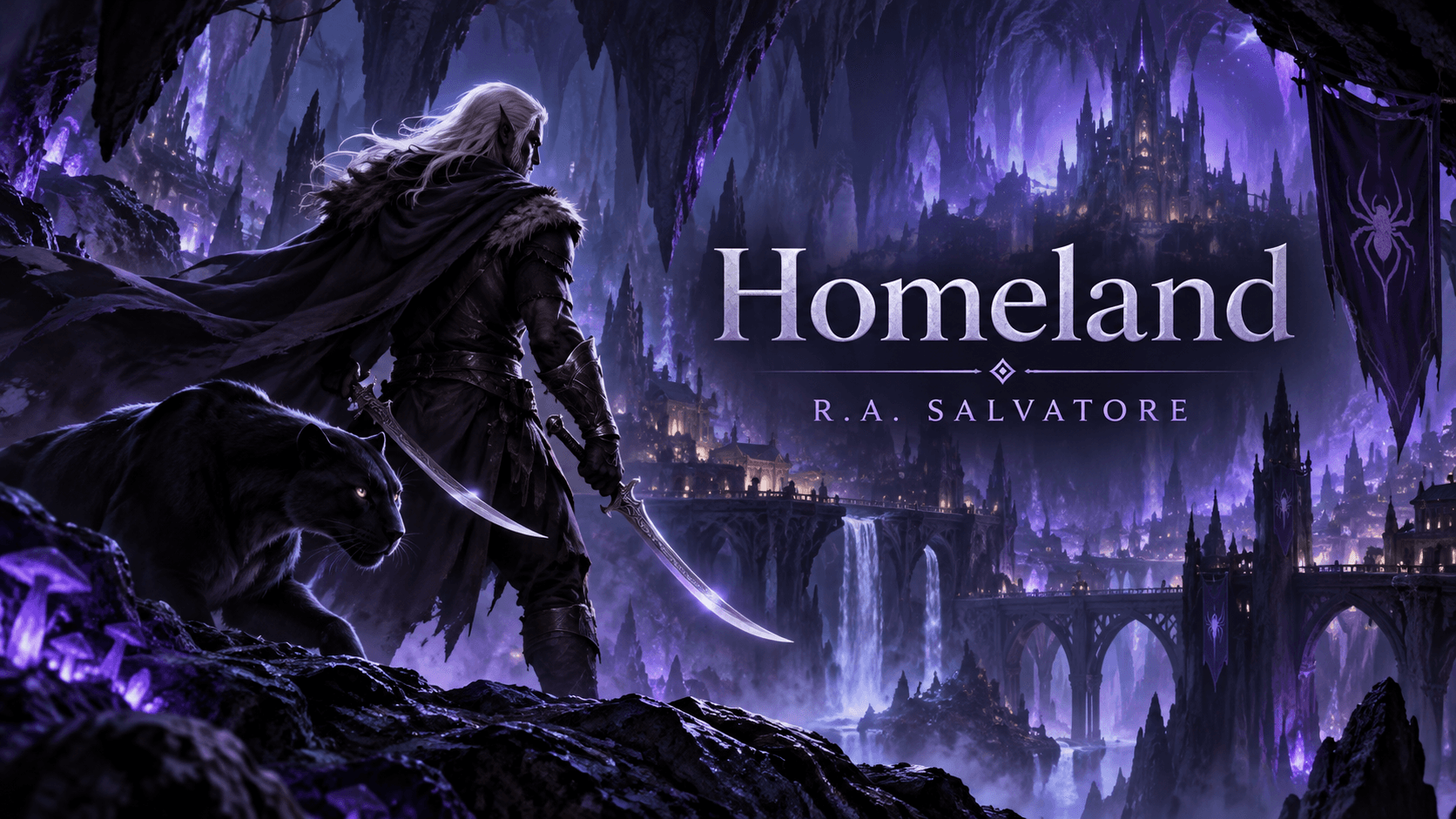

After years of consuming endless digital content and struggling with a shrinking attention span, I decided it was time to get back into reading. I started with manga, but picking up an actual novel felt like the real challenge.
Since I've been playing Dungeons & Dragons for the past two years, fantasy seemed like the perfect place to start. I wanted something that would entertain me, introduce me to more D&D lore, and maybe even inspire my own one-shots, mini-campaigns, and storytelling.
That's how I ended up discovering Drizzt Do'Urden.
And what a great introduction to fantasy literature it turned out to be!
The first thing that won me over was Salvatore's writing style.
It's fast-paced, accessible, and incredibly easy to visualize. His combat scenes were especially enjoyable. He gives you just enough detail to imagine every movement, every sword clash, and every confrontation without slowing down the action. For someone trying to rebuild a reading habit, that made a huge difference.
But Homeland is much more than a collection of exciting battles.
We follow Drizzt from his birth through his childhood and training, all the way to his eventual escape from the cruel society that raised him. Watching him slowly question everything he has been taught was one of the most interesting parts of the story.
The worldbuilding of Menzoberranzan and the Underdark was fascinating.
Drow society is a brutal matriarchy built around power, manipulation, religious fanaticism, and betrayal. The noble Houses constantly plot against one another, and assassination is practically an accepted political strategy. As long as a House can eliminate its enemies without leaving witnesses or evidence, even the destruction of another House can go unpunished.
I loved that twisted sense of politics, where everyone is plotting something and even your supposed allies might be your greatest enemies.
What makes this society even more disturbing is how deeply its beliefs are ingrained in its people. The Drow are raised to believe that the surface races are evil and inferior, while their own cruelty is presented as completely normal. The hypocrisy and constant manipulation make Drizzt's growing moral conflict even more compelling.
The relationships between the characters were another highlight.
Drizzt's relationship with his father, Zaknafein, stood out the most. In a society where affection and compassion are considered weaknesses, their bond feels genuinely meaningful. Zaknafein is one of the few people who understands Drizzt and recognizes that his sense of morality is not a flaw.
In contrast, his relationships with his mother and sisters show just how deeply the values of Drow society have corrupted the idea of family. Blood relations mean very little when ambition, status, and loyalty to Lolth come first.
I also enjoyed seeing Drizzt develop his incredible fighting skills, earn recognition through his abilities, and form his bond with Guenhwyvar, who quickly became one of my favorite parts of the story.
And then there are all the schemes, betrayals, and confrontations with people who pretend to be friends while secretly pursuing their own interests. They constantly remind you that in Menzoberranzan, trusting the wrong person can be fatal.
What stayed with me most, however, was Drizzt himself.
He grows up in a world that teaches him cruelty, yet he refuses to completely surrender his own sense of right and wrong. His journey isn't just about becoming a great warrior. It's about finding the courage to question the beliefs he was raised with and eventually walk away from everything he knows.
For me, that is what makes him such an interesting character.
Final thoughts
Homeland was exactly the kind of book I needed to get back into reading. It gave me exciting action, memorable characters, fascinating lore, and a world full of ideas I can draw from as a D&D player.
More importantly, it reminded me how enjoyable it can be to let a book create an entire world inside your imagination.