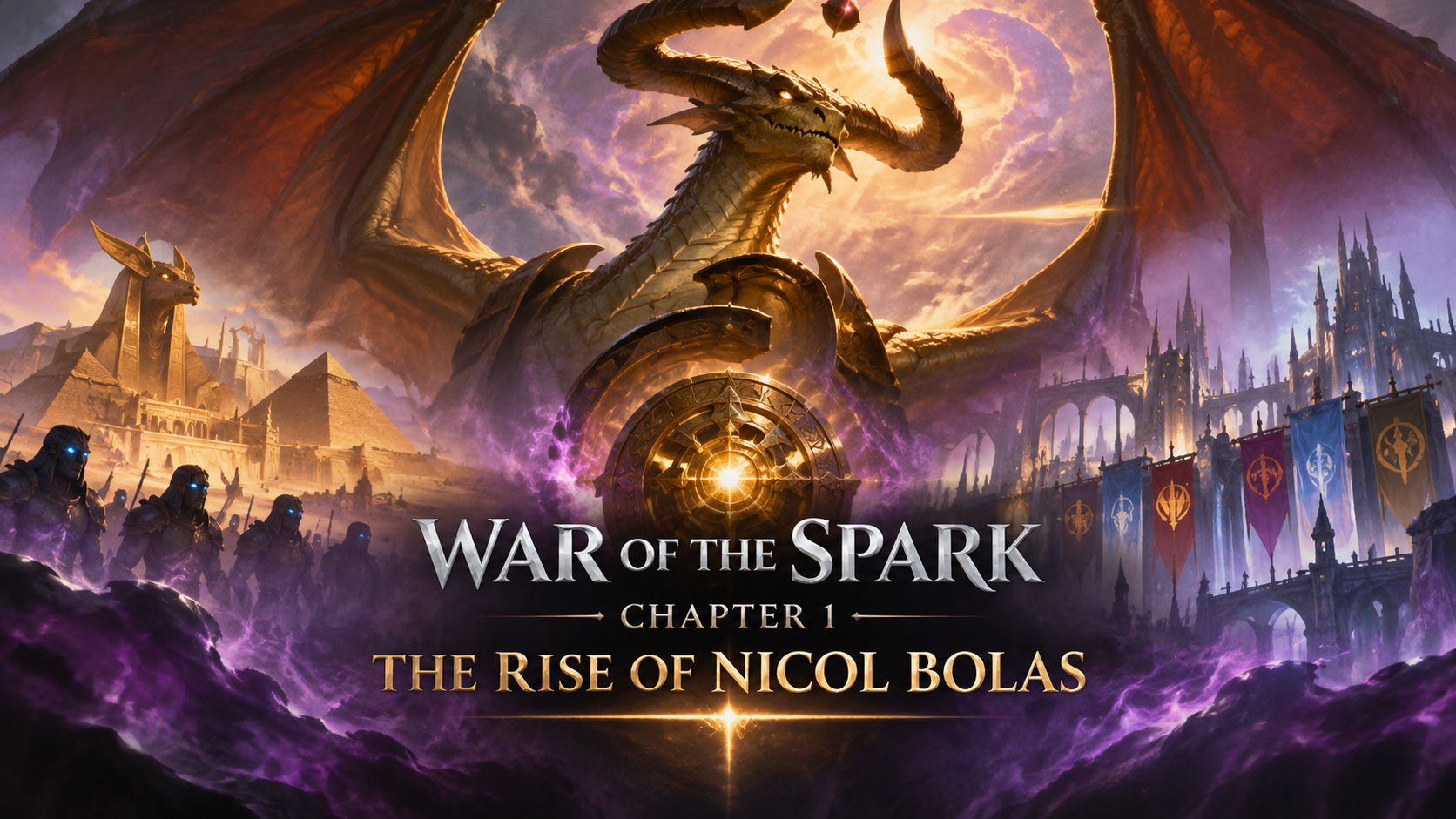


War of the Spark — Chapter 1: The Rise of Nicol Bolas
How one of the oldest and most powerful Planeswalkers in the Multiverse set a plan in motion that would lead to the greatest war Ravnica had ever faced.
A War Planned Long Before It Began
On Ravnica, an immense city that covers almost an entire world, ten powerful guilds compete for influence, authority, and survival.
Its inhabitants have endured political conflicts, magical catastrophes, and wars. But nothing could have prepared them for what was coming.
Somewhere beyond Ravnica, beyond the boundaries of any single world, an ancient dragon had already set a plan in motion that stretched across the Multiverse.
He was not merely seeking a throne. He did not simply want to conquer another city or bring another civilization under his rule.
He wanted to reclaim the power that had once made him almost a god.
His name was Nicol Bolas.
And to achieve his goal, he was willing to sacrifice entire worlds.
1. Before Nicol Bolas, There Was Nicol
To understand War of the Spark, we must travel thousands of years into the past, long before the Gatewatch existed and long before Ravnica became the center of the coming conflict.
Our story begins on Dominaria, one of the most important planes in Magic: The Gathering.
It was there that the Elder Dragons were born: ancient creatures of extraordinary magical power whose actions would shape the history of the Multiverse.
Among them were two twin brothers: Nicol and Ugin.
From the beginning, the brothers viewed the world differently.
Ugin was driven by curiosity and a desire to understand the nature of existence. Nicol, by contrast, learned to see power as the most important means of survival and domination.
Their differences were more than philosophical.
To Nicol, weakness was dangerous. Depending on others was a threat. And authority was the surest way to ensure that he would never be forced to submit to anyone.
Over time, he adopted the name Nicol Bolas and began building his own empire.
He used magic, intelligence, and his extraordinary ability to manipulate others to expand his dominion.
Where Ugin saw worlds filled with mysteries, Bolas saw opportunities for conquest.
And when their paths crossed again, conflict between them had become almost inevitable.
2. What Is a Planeswalker?
Before continuing, we need to explain one of the most important concepts in Magic: The Gathering.
The Multiverse consists of countless different worlds, known as planes.
Dominaria, Ravnica, Amonkhet, and Kaladesh are just a few examples.
Most inhabitants of a plane cannot freely travel to another.
Planeswalkers, however, possess something exceptionally rare: a Planeswalker Spark.
This is a magical potential found in certain beings. Once ignited, it allows them to travel between worlds.
This journey is known as planeswalking.
In the earliest eras of Magic, before an event known as The Mending, Planeswalkers possessed powers far greater than those of most modern Planeswalkers.
They could accomplish feats that appeared godlike to ordinary mortals.
Nicol Bolas belonged to this older generation.
And he had come to regard that immense power as an inseparable part of his existence.
3. The Mending — The Day the Gods Lost Their Power
The Multiverse did not remain unchanged.
For centuries, catastrophic events and tears in reality threatened its stability.
Eventually, a series of events led to The Mending, the restoration of these fractures and a fundamental transformation in the nature of Planeswalkers.
The Multiverse was saved from an enormous threat.
But the price was devastating for the old Planeswalkers.
Their nearly limitless power was dramatically reduced. They were no longer the extraordinary beings who could reshape reality with the same ease as before.
For many, this meant learning to adapt to a new era.
For Nicol Bolas, it was something far worse.
It was humiliation.
The dragon who had survived for millennia, defeated countless enemies, and built empires now faced the limitations of his own existence.
He remained terrifyingly powerful.
But he was no longer what he had once been.
And Bolas could not accept that reality.
From that moment onward, reclaiming his former power became the central objective behind his schemes.
It was not enough for him to rule the Multiverse. He wanted to return to an age when he could stand above it like a god.
4. Amonkhet — A World Turned Into a Factory for Soldiers
One of the most important pieces of Bolas's plan lay on Amonkhet.
Amonkhet is a world inspired by ancient Egypt: vast deserts, imposing temples, animal-headed gods, and a society built around religious devotion.
At the center of this civilization stood the city of Naktamun.
Its inhabitants believed that their world was ruled by a powerful and benevolent God-Pharaoh.
They worshipped him, obeyed his commands, and prepared themselves for a glorious afterlife.
What they did not know was that their God-Pharaoh was Nicol Bolas.
Bolas had shaped their religion and society to serve a very specific purpose.
The young people of Amonkhet underwent a series of trials, known as the Trials, to prove their worth.
They believed that success, followed by their ultimate sacrifice, would earn them a place in the glorious afterlife promised by their god.
In reality, the trials served as a system for selecting exceptional warriors.
The worthy dead were destined to become Eternals.
The Eternals were elite undead soldiers enhanced with lazotep, a special mineral found on Amonkhet that coated and protected their bodies.
They were more than an army that would obey Bolas.
They were a weapon created through generations of people who believed they were serving a god.
The tragedy of Amonkhet was that its inhabitants had devoted their lives and deaths to preparing for a war they did not even know would happen.
And when the Hour of Devastation arrived, the true nature of the God-Pharaoh was revealed with catastrophic consequences.
Naktamun was devastated, gods fell, and Bolas demonstrated just how little he valued the lives of those who worshipped him.
But the army he needed had been created.
5. The Gatewatch and Their Crushing Defeat
Nicol Bolas was not unknown to the heroes of the Multiverse.
A group of Planeswalkers known as the Gatewatch had formed to confront threats that extended beyond the boundaries of a single world.
Among its most important members were Gideon Jura, Jace Beleren, Chandra Nalaar, Nissa Revane, and Liliana Vess.
When the group arrived on Amonkhet, their goal was to stop Bolas.
But the confrontation did not unfold as they had expected.
Bolas was far more powerful and better prepared.
Instead of facing an enemy they could defeat through teamwork and determination, the Planeswalkers encountered an opponent capable of overwhelming them.
The Gatewatch was defeated.
That defeat mattered enormously, not only because it demonstrated Bolas's strength, but because it exposed the limitations of our heroes.
Gathering several powerful Planeswalkers and launching an attack was not enough.
Bolas was not simply another enemy.
He was an ancient strategist who planned his moves long before his opponents realized they were part of his game.
And the battle on Amonkhet was not the end of his plan.
It was only one stage.
6. The Three Instruments of the Trap
To achieve his ultimate goal, Bolas needed more than an army.
He had to gather numerous Planeswalkers in one location, prevent them from escaping, and use the Eternals to take their Sparks.
Three elements were essential.
The Planar Bridge
The Planar Bridge was created on Kaladesh, an extraordinarily advanced technological device capable of opening a passage between different planes.
Most importantly, it could transport inorganic matter between worlds.
This limitation made the lazotep-coated Eternals particularly useful to Bolas's plan.
With the assistance of Tezzeret, who incorporated the Planar Bridge into his own body, Bolas gained the means to transport his army from Amonkhet to Ravnica.
The Immortal Sun
The Immortal Sun was a powerful magical artifact originally located on Ixalan.
One of its most important properties was its ability to prevent Planeswalkers from leaving the plane on which it was located.
In Bolas's hands, that power could turn an entire world into a prison.
If Planeswalkers gathered on Ravnica, the Immortal Sun would prevent them from escaping.
The Planar Beacon
But the trap would be useless if the Planeswalkers never arrived.
This was where the Planar Beacon came into play.
The Planar Beacon was a magical construction on Ravnica capable of attracting Planeswalkers from across the Multiverse.
Bolas intended to use the Beacon to draw them to Ravnica and the Immortal Sun to keep them there.
Then his army of Eternals would carry out the next stage of the plan.
Three different instruments, originating from different worlds, ultimately served a single purpose.
And everything led to Ravnica.
7. The Elderspell — Bolas's True Objective
At this point, someone might believe that Bolas was simply preparing to conquer Ravnica.
But Ravnica was not his true objective.
It was the battlefield where he intended to gather his victims.
The key to his plan was the Elderspell.
The Elderspell was a terrifying magical spell that would allow Bolas to absorb the Sparks of other Planeswalkers.
The Eternals would kill the trapped Planeswalkers and harvest their Sparks, which would then be channeled into Bolas through the Elderspell.
Every Spark represented another step toward reclaiming his former power.
And the more Planeswalkers gathered on Ravnica, the greater the power he could acquire.
The army of Eternals had not been created simply to win a battle.
It had been created to eliminate Planeswalkers.
The Immortal Sun was not intended merely to prevent an enemy retreat.
It was intended to keep the victims inside the trap.
And the Planar Beacon was not a call for help.
It was the bait.
All of Bolas's individual schemes, from Amonkhet to Kaladesh and Ixalan, were finally beginning to reveal their true purpose.
8. Why Ravnica?
Ravnica was one of the most politically and magically significant worlds in the Multiverse.
Its society was organized around ten guilds, each with its own ideology, authority, and interests.
The balance between them was fragile.
Bolas exploited this situation by placing allies and agents in positions of influence.
Dovin Baan gained control of the Azorius, Vraska became the leader of the Golgari, and Domri Rade took command of the Gruul.
Not all of them had the same relationship with Bolas, nor did they all understand the full extent of his plans.
Nevertheless, their actions contributed to the destabilization of the city.
Meanwhile, conflicts between the guilds made it increasingly difficult to establish a united defense.
Ravnica was becoming vulnerable.
And within this city, Bolas's technology, magic, and political manipulation would converge to create a trap on an unprecedented scale.
9. The Final Moments Before the Storm
For most of Ravnica's inhabitants, life continued.
The guilds competed against one another. Political conflicts intensified. Alliances shifted, and uncertainty spread.
Few could imagine what was truly approaching.
An army of undead soldiers waited on another world.
A magical artifact could prevent the most powerful travelers in the Multiverse from escaping.
And a device was ready to attract those very Planeswalkers to the place where Bolas wanted them.
The ancient dragon had spent years preparing for this moment.
He had transformed an entire civilization's faith into a military machine. He had exploited inventions from other worlds. He had manipulated leaders and provoked conflicts.
All for one purpose.
To reclaim the power he had lost.
Ravnica did not yet know it, but it would soon become the center of a war that would bring Planeswalkers together from across the Multiverse.
Nicol Bolas was not waiting for the war to begin.
He was waiting for the trap to close.
In the Next Chapter
Chapter 2 — The Gathering Storm: Ravnica Before the Invasion
Tensions between the ten guilds, the heroes' efforts to uncover Bolas's plan, and the events leading to the activation of the Planar Beacon.
The storm is approaching. And this time, no Planeswalker is safe.